Showing posts with label painting. Show all posts

Monday, May 14, 2012

Beauty In The Beast


This is the post where I finally convince myself of the beauty of one of my latest art works. The painting, titled “Dark Goddess,” is included in a Florida Artist Group exhibition in Sarasota, judged by well-known painter/printmaker Tom Nakashima. During his introductory speech, Nakashima shared with us the fact that he never assigns deep philosophical meanings to his work before or during the creative process. Only later does he wrestle with the piece’s significance for him. He added that with the passage of time and circumstances, people’s views of his work may change, but those various meanings would remain as valid as his own.

I had, for a long while, been steadfast in my ambivalence toward “Dark Goddess.” At different times in its creation, I had been repulsed and then attracted by the figure’s brooding presence.

The eyes were set too close together, the mouth too large. The hair, if it could be called that, seemed to jump off the head or later retreated into the background. At those intervals, the piece embodied pure ugliness to me. I stayed out of her sight for days.

Persistence, in service to a learned work ethic, always drew me back. What would happen, I wondered, if a stylized black veil were placed over her face. Would a lighter background make the figure stand out more. At one point, in desperation, I even poked holes throughout the thick paper.

Gradually, working on the piece, I began to see something resembling beauty in parts of the whole- the impasto of buttery oil paint next to transparent acrylic passages. Scrumbled lines competing with blocks of color, and just peeking through, the original black ink outline. I became enthralled by the lush physicality of paint.

A deadline forced me to stop and with trepidation the piece was signed, sealed and delivered, not to be seen again until opening night.

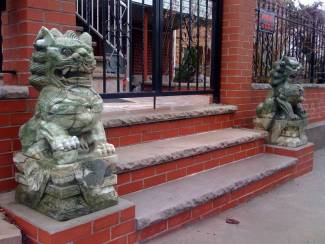
Viewing “Dark Goddess” in a large gallery after listening to Mr. Nakashima, I realized I had mistaken ugliness for fierceness. My thoughts flashed on those fierce Fu Dog statues guarding Chinese temples. I remembered black and bloody Kali, Hindu goddess of death and destruction. The ancients knew one does not confront monsters and demons with puppies or pretty girls.

Driving back in darkness over the Sunshine Skyway, I tangled with the idea that “Dark Goddess” represents the terrible fierce beauty that protects us against life. Now I am convinced of it.


Saturday, April 7, 2012

Thomas Kinkade Dies At 54


Thomas Kinkade died much too soon and that is sad, but I do not mourn the passing of his so called artistic creativity. Kinkade's talent lay in marketing hype coupled with a massive ego, which are on full display in this 60 Minutes segment.

Tuesday, March 27, 2012

Egon Schiele


Years ago, I viewed a major exhibition of Egon Schiele's paintings and drawings at MoMA. Photographs of his work in Art History 101 had not prepared me for the nuances of Schiele's startling imagery.

Standing in front of his large canvasses, bits of contrasting colors, scrumbled lines and underpainting became abundantly clear. Even Schiele's finished paintings have a mosaic-like drawn quality that I found quite appealing.

These were not erotic in the sense of being titillating, but were rather illuminating, as one realized Schiele's masterful draughtsmanship, sense of color and love of form.

Monday, March 19, 2012

Mindy Solomon Gallery


“All architecture is shelter, all great architecture is the design of space that contains, cuddles, exalts, or stimulates the persons in that space.”
Philip Johnson

There is a similarity in architecture and sculpture in that both deal with space, either contained or surrounded. These two art forms come together and can be seen to enhance each other in a thoughtful well designed art gallery.
That is the feeling one gets on first entering Mindy Solomon Gallery in St. Petersburg, Florida. Located in that city’s downtown arts core, the small gallery exalts space with 25 foot ceilings, an open floor plan and abundant natural light. The airy space seems larger because of it.

This is not an interior unto itself, but intended to show off its contents, in this case an exquisite exhibition of Korean ceramics and paintings. With muted colors and elemental forms, these vessels and wall-pieces are perfect objects for the minimal gallery space.
"My House 2"
Kang Hyo Lee
One is drawn to contemplate each piece and the process of looking can become a simple meditation. Perhaps because of the artists’ Oriental esthetic, I went away with the feeling of having experienced something reverent.

Meditative Journeys at Mindy Solomon Gallery runs February 25- March 31. The Gallery is at 124 2nd Avenue NE, St. Petersburg. 727 502-0852.

(photos courtesy of Mindy Solomon Gallery)

Tuesday, March 13, 2012

Hot Wax Treatment

Reflections 21, encaustic painting, Leslie Neumann

Encaustic (n.)
1. A paint consisting of pigment mixed with beeswax and fixed with heat after its application.
2. The art of painting with this substance.
3. A painting produced with the use of this substance.
[Latin encausticus, from Greek enkaustikos, from enkaiein, enkau-, to paint in encaustic : en-, in; see en-2 + kaiein, to burn.]

I first became acquainted with Leslie Neumann’s encaustic paintings in 2004, when we exhibited in adjoining galleries at the Morean Arts Center in St. Petersburg. While not a stranger to the hot wax process, I quickly realized what deep beauty can be achieved by the hand of a master.
Leslie’s landscapes have a softness of form with layers of subtle transparency which give her compositions depth and perspective. This is painting as a window, drawing the viewer into a rich and luminous other world.

On a subsequent visit to her Aripeka home and studio, I learned more about Leslie’s exacting technique, as well as her commitment to preserving Florida’s unique wild habitats. From her third floor studio balcony, we looked out over an almost pristine coastal estuary turned golden by the setting sun. One could not ask for a more inspiring setting in which to make art.

Leslie and eight other artists using the encaustic method will be featured in “Wax: Medium Meets Message,” an exhibition at the Morean which opens this Friday, 5-7 pm with an artist’s talk at 5 pm.
www.moreanartscenter.org 

Image courtesy of the artist

Thursday, July 28, 2011

Art For Our Sake

c. Jonathan Hillyer Photography Inc.
courtesy High Museum of Art, Atlanta

Deep into the dog days of Florida's summer, afternoon finds me momentarily at odds with my calling. I should be painting but the drip-dry heat chases me from the studio. My inner editor advises catching up on art books but workers arrive to install a back door. My last refuge for today becomes the computer screen.

One of the first things to jump out at me is how call to artist sites have changed. Scanning an updated list of shows on the Cafe site gave me a chalk art show in El Paso, an exhibition celebrating Edgar Allan Poe in Boston, a photography show about the Flint Hills in Kansas, a ceramic cup competition in Kansas City, an energy conservation art exhibition in Seattle and a competition celebrating Latino, African and Asian heritage.

In my quick glimpse, only one show made a call to contemporary painters - the Portland 2012 Contemporary Biennial. Unfortunately, the exhibition is limited to Oregon artists.

Even at the local level, there has been a remarkable increase in the number of thematic and multi-media exhibitions. Some of the themes have included dogs, tea cups, tiny art, and psychological states. And it is no longer de riguer to attend just art exhibitions. There must also be something interesting going on - a poetry slam, a charity auction, wine tastings, music concerts.

Pity the poor person who stumbles into a gallery of beautiful and challenging paintings and has nothing but the silence of her thoughts to fall back on.

Tuesday, June 28, 2011

Artist Profile: Denis Gaston - Pinellas County Cultural Affairs Interview


Here is a studio interview from a few years ago. I just now learned how to convert it to YouTube.

Monday, June 13, 2011

Letters From Home

Silent Sentinels, enamel on wood panel, 1969, Kandauer
  My father, Richard Gaston, a cartographer and publisher by trade, took up painting in the late 1940's. He especially loved the German abstract painters and invented his nom d'artist Kandauer, combining the names of German painters Wassily Kandinsky and Joseph Bauer.

After I moved away from home to make my own mark in the art world, Dad gave me one of his favorite pieces called Silent Sentinels. The work seems to say a lot about the artist - a person with deep and complex roots, but silent and closed off to the world. At least that is the feeling I had of him, perhaps reflecting some of my own cloistered insecurities.

Silent Sentinels has been a companion ever since, moving with me many times and becoming a featured piece in my growing art collection. Recently, some old letters from my father resurfaced and forced me to reconsider my ideas about him. Written in masterful cursive, the letters reveal the hopes, dreams and doubts of a man and an artist as he confronted himself and an often indifferent world.

The letters covered a brief time frame when I struggled with acceptance and my own sense of identity. Rereading them after forty years gave me a shiver and brought me closer than ever to a man I wished I had known better.

Saturday, June 11, 2011

Waiting For The Paint To Dry


GlobeStalker, oil on canvas, Denis Gaston
    "Waiting for the paint to dry" could be a metaphor for the many times I am not painting, whether seeking out inspiration, thinking about what to paint or simply cleaning out the studio. These are all important and necessary precursors to the desired goal of putting paint on canvas.

     They may also exist as thorny obstacles to that becoming thing - the lonely challenge of creating something from nothing. Today and yesterdays seem as if the paint will never dry.

Thursday, June 2, 2011

Seen And Not Seen


"Winter Storm Approaching"
oil on panel, 2011, Denis Gaston
Looking at art is different from seeing art. Looking at art can be a casual glance as when one scans the environment while walking, taking in the barking dog, the mailman and passing traffic.

When a person enters an art gallery, they quickly look all around until a certain piece catches their eye. Standing before the work, the process of seeing can begin. The painting’s content, color and composition actively engage the senses. Questions may arise and some kind of appreciation begins forming at a subliminal level.

If a certain art work affects us in a profound way, there can even be a physical response.

Jackson Pollock’s paintings take our breath away. Renoir’s color drenched pieces convey joy and contentment. Seeing art in this sense, is analogous to understanding it, not in some bookish intellectual way, but as a more personal and satisfying experience.

Wednesday, November 3, 2010

Elizabeth Murray, Painting From The Body


Here is a short video of Elizabeth Murray, one of my favorite artists. A hugely talented painter and woman of no conceits, Murray sadly passed away in 2007 at the age of 66.

Friday, April 16, 2010

Faces At An Exhibition


Here is a group portrait of a just finished project that has taken a big chunk of the last six months. Most of these mixed-media works were painted with a palette knife on 9" by 9" prepared masonite.

Working quickly in a small format challenged me to concentrate on the essential gestures. Several 4' by 5' blank canvasses now lean against my studio wall waiting for the next challenge.

Sunday, April 11, 2010

The Great White Hunter

Today I finished the last painting of a portrait series I’ve been working on for six months. The nine mostly mixed-media pieces on masonite comprise a group of iconic figures that sprang from the imagination.

With no apparent antecedents in the world out here, they function more like emotional signposts – states of mind with which to become acquainted.

Working in a rapid wet on wet method with a palette knife gave me the opportunity to quickly capture fleeting images. I’ve just now reached the point of feeling comfortable with this gestural painting style – comfortable as I can be in a nine by nine inch format. Four by six foot canvasses lean against my studio wall, an all too obvious next challenge.

Wednesday, March 31, 2010

Perfectly Imperfect

Living life is often a scary proposition and the artist's job is not to turn away from the unpleasant stuff we come up against. Grab hold of the fear and loathing and force them into one's visual vocabulary. Lately, the results for me have been a kind of Fu-Lion art.

Many Chinese temples are guarded by two fearsome Fu-Lion statues. Their purpose is to keep out demons, the bad guys who continually try to force us off the path. Fu-Lions also give people the opportunity to call up and examine their own fear and anger.

Pictured above is a new work titled Red Tara, a Fu-Lion figure of protection. It is a mixed-media piece on masonite and will be included in an upcoming exhibition.

The exhibition, called Perfectly Imperfect, will he held at The Painted Fish Gallery in Dunedin. I am pleased to be showing with master potter Yasuko Nakamura, whose beautiful ceramic vessel Love Like Wind is pictured at left.

The opening reception will be Friday, April 9, 6-9pm. 727 734-5060. More information.

Saturday, March 27, 2010

Stealers Choice

Authorities recently recovered a painting by Swiss artist Paul Klee, stolen in 1989 from New York’s Marlborough Gallery. After so many years, a Florida art dealer attempted to sell the painting, Portrait in the Garden, to a Montreal gallery.

High profile art thefts are almost always done for the money and almost always fail. It becomes nearly impossible to move big ticket art works, as the above story illustrates, even after 20 years. They are too much in the public’s consciousness.

But what of lesser known artists? Are their works often stolen and for what reasons? I suspect less well known works of art get pinched for those typical human conditions – jealousy, revenge, greed, and even love.

Stealing art because one loves it turns out to be the most interesting situation. It’s been said that imitating art is the sincerest form of flattery. Perhaps that aphorism can be carried further and restated – “Stealing art is the sincerest form of flattery.”

This type of art thief must love the work very much to go to the extreme of stealing it. They would be taking a huge chance of getting caught with the unpleasant prospect of landing in jail. Minus the stealing part, these are just the kind of people artists dream about.

In the mid 1970’s, I participated in the first Piedmont Park Art Show in Atlanta. My booth consisted of one odd little piece titled Electric Lick, an animated sculpture featuring a rubber tongue. Returning from an afternoon food run, I was surprised to discover an empty pedestal. The sculpture was gone. Who rips off art I complained to show organizers. They both agreed it must have been someone who really loved the piece.

After I cooled down and had time to ruminate on it, I realized the Piedmont ladies were right. That reassuring thought was some consolation to a lost weekend of browsers and no sales.

A couple of weeks after the show, I returned home to find my apartment had been broken into. The back window was forced open and muddy footprints covered the floor. Searching everywhere and double checking hidden valuables, I realized not one thing was missing. Someone had broken into my wonderful apartment filled with fabulous art and found nothing worth stealing.

How dare them! It could only have been some low-life punk completely devoid of good taste. Sitting on my Day-Glo yellow designer bean bag, I stared at the still empty pedestal and remembered the Piedmont Park art thief. “Why couldn’t it have been him! He at least knew great art!”

Wednesday, December 16, 2009

Searching For Art

A recent St. Petersburg Times story, “Seeking but never finding,” caught my attention. According to behavioral scientists, there is a biological explanation why we’ve become addicted to Google searches.

It appears this activity stimulates a region of the brain called the lateral hypothalamus, or “seeking center.” The constant arousal of this region is what compels people to sit for hours at a computer googling. Some psychologists believe that doing this over time renders us unable to perform concentrated thinking or extensive reading.

I can now disclose that I have first hand experience of this new phenomenon. Last month, after moving my art studio back home, it became necessary to rearrange my workspace. The living room has again become the matting and framing area. The dining room table now doubles as a wet- media work station.

Taking advantage of the only available north light, I placed my drawing board by the bedroom window – directly across from the computer. Bad move!

Creating for me requires an empty mind, so before beginning each day, I must first sweep out the place. Every distracting thought skulking in the corner is pushed out the door, every yapping desire temporarily chained outside. Only then in the emptiness of the present moment does inspiration show itself.

This process is difficult in the best of times. Throw in the instant gratification of one Google fix and another and another and making art gets down right impossible.

I wonder who the world’s tallest man is.
Google: “Sultan Kosen, a Kurdish shepherd living in Turkey is 8’1.5” tall.”
Kurds? Aren’t they the largest ethnic group without a country?
Google: ‘There are about 35 million Kurds today living as minority populations in Turkey, Iran, Iraq and Syria.”
What is the capital of Syria?

Hours later I look up and wonder where the time went. A blank canvas remains on the easel. Clean brushes are lined up waiting to be pressed into service. The Google home page glows from my monitor.

I wonder who the world’s shortest man is.

Friday, September 18, 2009

Amedeo Modigliani

I knew nothing of the personal life of Amedeo Modigliani when first introduced to his art in college. Only later, after reading his biography, did I learn about the man and a life of sickness, poverty, and addiction. Dead of tuberculosis before the age of thirty-six, Modigliani had only one solo exhibition in his lifetime, and gave away many of his paintings for food.

No introduction to his art was needed. The pain, sorrow and dark beauty of his life were present full force in his paintings, making an immediate and profound impression. Yet there is another element of Modigliani's work that I find particularly appealing. I cannot look at his sublime portraits of women without also feeling a sense of allure, a hint of danger, and, above all, mystery. And isn't that, after all, what we look for in women.

Monday, August 17, 2009

Under The Bed

Later this month I will shut down yet another temporary studio and move into brand new digs, the Stirling Hall Studios in downtown Dunedin.

The grunt work of packing now begins and I am rediscovering art pieces squirreled away nine months ago. It is good to see old friends emerge from closets and crannies, dusty, but no worse for the wear.

This pastel painting titled Ol' King Cole was pulled from beneath the bed, and may explain some of the regal dreams I have lately experienced. The piece also makes me wonder if an art work can truly be called finished if no one ever sees it.

Friday, August 14, 2009

Henri Matisse

One of my college art classes was a studio course called Methods and Materials of the Artist. After an introduction to the various media, we were given the assignment of reproducing a work by a 20th Century master. The catch was that we must stick to a 9" x 12" format and use a medium other than the one used by the artist.

I chose to reproduce in gouache one of the many still-lives of Henri Matisse. After laboring for a long and frustrating week, I finished the piece just before the deadline. Not much more is known, except that I somehow passed the course. The still-life ended up in my portfolio and after graduation became a gift to my parents.

Placed in an antique frame, the piece held a place of honor in their home for years. One day, a visitor to my mother's antique shop stopped to admire her painting collection. Standing in front of my class project, she leaned in close to read the signature and her mouth fell open.

She slowly turned to my mother and with mounting excitement said, "I'm not positive, but I think you might have an Henri Matisse painting."

In that moment, my mom made the decision to have some fun and play along with her visitor. "Oh goodness, do you really think so?"

The lady did think so and nothing would do except for her to take the piece to a friend for authentication. Her friend turned out to be one of the curators at the Ringling Museum of Art in Sarasota.

My mischevious mom resisted the urge to halt the ruse and handed over the still-life. Weeks passed until one day the visitor called with promising news. The Ringling curator had thoroughly examined the piece and agreed it might indeed be a Matisse.

"The only way to know for sure," he said, "is to show it to Matisse's son Pierre in New York."

At that point, my mother thought it best to end the charade. She had the art returned and continued to enjoy her 'masterpiece' for many more years.

Thursday, June 18, 2009

Mixing Up Some Media

While waiting for new studio space to open, I labor in the confines of a small apartment turned atelier. My dining table doubles as a drawing board, the tea table a framing station. As my focus narrowed, large works got shoved under the bed and I once more made friends with #0 brushes.

For the Cool Art Show in St. Petersburg next month, I will have many five by seven inch drawings. Nine inches by nine inches is now a large work and that is the size of Bell-Hop at the Sands Hotel (above) - an example of mixing some media on masonite.